

PAGE FIVE
Warsaw - Andrew and Jacqui - 2010

Palace of Science and Culture, Warsaw
We arrived at Warsaw very early in the morning on the overnight train from Cologne. We emerged from Warszawa Centralna Station to see the Palace of Science and Culture looking magnificent and huge floodlit for the night. We would return there some days later, but for this day our itinerary featured food and sleep ... not necessarily in that order.
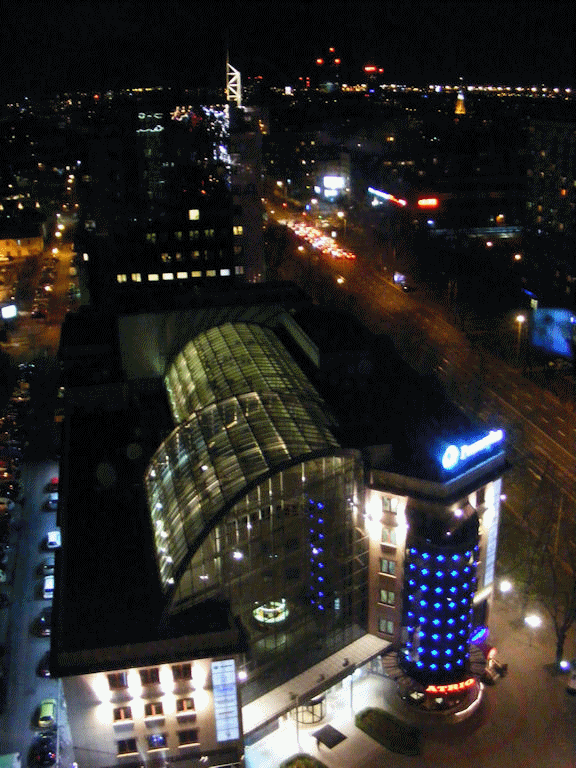
Warsaw at Night from our Hotel
A taxi ride later we checked in to the Westin on Jan Pawła II Avenue and, basically, bummed around for the day. We did get as far as across the road to eat in the magnificent Atrio restaurant, the first of many great meals we would have in Poland on this trip.

Wet Day in Warsaw's Old Town
The next day we headed off to Gdańsk for the business part of the trip. Gdańsk is a torturous six hour train journey away, and an even more torturous six hour train journey back a couple of days later.

Zygmunt Column, Warsaw
We now had two days in Warsaw and the first day was, naturally enough, set aside to visit the Old Town. Unfortunately the weather decided to be wet and grey this particular November day, and so we took the taxi to Plac Zamkowy in the hope that the rain would not stick around all day!

Plac Zamkowy, Warsaw
Plac Zamkowy, or Castle Square, is one of the focal points for the Old Town of Warsaw. It is dominated by Warsaw's Royal Castle on one side and the Sygmunt Column in its centre. One thing it is worth understanding from the very start about Warsaw and particularly about the Old Town is that none of it is much older than 60 years.

Old Town, Warsaw - destroyed after World War II
In 1944 as the Allied Forces looked to be driving the Nazis out of Europe the Polish in Warsaw decided now was the time to free themselves from the Nazi oppressors. The Red Army was camped on the Praga side of the Wisła and so the Warsaw Uprising begin in the hope of support from the Russians. In what could politely be called a calculating move, or less politely a cold hearted act of collaboration the Red Army stayed put whilst the Uprising was put down. After two months of fighting 200,000 Polish were dead - any that survived were marched from the City to the camps. The Nazis then set about systematically destroying every building in Warsaw. The Old Town was targeted first and scarcely a building stood after the destruction was finished. In January 1945 the Red Army took possession of the ruined City and Communist rule in Poland began.

Alleyway in Warsaw Old Town
Almost all you see today is a
reconstruction, much from
the 1950s, but some work from as late as the 1980s.
Warsaw seems to enjoy playing up this angle of the terrible things that happened in World War II (both the Uprising and the Ghetto before it) but this is putting itself in an unnecessarily bleak light. The reconstructed Old Town is a magnificent jumble of colourful structures perfectly rebuilt, the Castle is a dominating structure and some of the modern buildings further from the Old Town are also attractive.

Picturesque Window, Warsaw Old Town
The rain, sadly, did not want to behave on this particular day and after a while sheltering overlooking the Castle we decided to make the best of it, huddled beneath our umbrella and set off for a wander.

Wet Jacqui in Warsaw
One particularly attractive alleyway, all blue stucco and iron railings, led down to a small viewing platform from where a view over the Wisła to the Praga District could be had ... or at least could be on a better day, today the rain obscured distant objects in a mist of drizzle.

Wet Andrew by the Wisla in Warsaw
We took some pictures of each other here, umbrella in action, looking surprisingly jolly despite the weather conditions. This was mostly because we were rather enjoying Warsaw's Old Town despite the rain.

Old Town Square, Warsaw
The weather hadn't improved any by the time we arrived at the Old Town Square. The original buildings here dated to the 13th Century and were rebuilt to original plans by the Communists in the years following World War II. In the centre is the Syrena statue. The Mermaid is the symbol of Warsaw - a bizarre thing in a City so far from the sea. As with most things in Poland there is a folk tale behind her ... Prince Kazimierz, out hunting, got lost in the marshes around where Warsaw would be ... rescue came in the shape of the Mermaid who guided the unlucky Prince to safety - and so Warsaw was built here.

Syrena - Warsaw's Emblematic Mermaid
The original Syrena statue (there are
three main ones
in Warsaw) is now in a Museum. The model for the statue, the actress
Krystyna Krahelska, was mortally injured on the first day of the
Uprising.
The statue in the centre of the Old Town Square is one of those focal points that many cities have around a particularly poignant or impressive piece of sculpture. This one, by Ludwika Nitschowa, is most impressively done with a dynamic pose and a deft eye for drama. It looked particularly good with the rain pouring down its sinuous female half ... a Mermaid would have been very much at home in Warsaw during our visit!

Warsaw's Mermaid
Continuing our explorations we suddenly found ourselves at the Barbican Gate and realised that we were across the other side of the Old Town already. Beyond here is the "New" Town (i.e. the 17th Century expansion of Warsaw), but the weather began to close in once more and we decided to turn around and head back towards the Castle.

Warsaw's Barbican
Along the way we came across the Cathedral of St. John (reconstructed like 90% of the Old Town) and popped inside for a respite from the weather. The interior of the Cathedral is surprisingly sparse for a Catholic Cathedral, although as we were leaving we happened upon the sudden riot of colour and gilt that is the Chapel of the Immaculate Conception.

Chapel of the Immaculate Conception, Warsaw Cathedral
Directly next door to the Cathedral is the Jesuit Church decorated with a deep pink stucco and like everything else rebuilt after 1945.

The Jesuit Church in Warsaw Old Town
By this time the weather had reverted to just a drizzle so we set off down the Royal Route of Warsaw (all Polish cities seem to have one of these). This one goes from the Castle at one end to the Łazienki Park at the other.

Warsaw Castle
Looking back towards the Old Town there were some great views of the jumble of ancient rooftops and spires (albeit new versions of ancient) with Zygmunt up on his column keeping watch.

Looking Out of the Castle Courtyard, Warsaw

Jumble of Rebuilt but Ancient Structures in Warsaw Old Town

The Start of the Royal Route in Warsaw
At the entrance to Krakowscie Przedmieście which starts the Royal Route (coming from this direction) is St. Anne's Church which is one of the few to have survived World War II with only relatively minor structural damage. The roof and the interior were pretty much destroyed, but much of the building itself managed to stay intact.

St. Anne's Church, Warsaw with the Viewing Tower
For the tourist one of the main attractions is the detached bell tower. For only a few złoty you can scramble up the winding stairs to a viewing platform.

View from St. Anne's Church Tower, Warsaw
From here a magnificent view of the Old Town can be had. Perhaps the best view in Warsaw (although see the Palace of Science and Culture below).

Zygmunt on his Column, Warsaw
In particular the views down to Plac Zamkowy and those of the Castle itself are worth the climb and even on a rather damp and overcast day such as this one the jumble of colours and terracotta roofs is a joy and one does find oneself forgetting that everything you are looking at is a 20th Century rebuild. If only the UK's cities had been rebuilt so well after World War II destruction ... how much better would Coventry look if it had not been created anew in concrete?!

Viewing Warsaw Castle from above
Looking the other way the Royal Route snakes off into the distance, lined with rebuilt 17th Century buildings and in the distance Poland's tallest building - the Palace of Science and Culture - stands brooding on the skyline.

Warsaw's Cathedral from St. Anne's Church

St. Martin's Church, Warsaw
Although the views were great at the top of St. Anne's Church bell tower, the weather was not particularly conducive to a long linger and so it was back down again and off along the Royal Route stopping at market stalls (selling Polish staples like smoked cheese and, of course, amber) and in various shops.

The Start of the Royal Route in Warsaw
The route takes you past various churches and palaces, the University and the famous Hotel Bristol before arriving at a small square overlooked by Holy Cross Church. This is the most renowned of Warsaw's churches outside of the Old Town. Mainly this is because the heart of local boy Frederic Chopin is interred in an urn in a column inside.

Holy Cross Church, Warsaw
Warsaw makes a lot of its Chopin
connections, even
though he wasn't actually born here and he left when he was only 20
(that said only 19 years later he was dead). Dotted around are benches
which play Chopin's music when you sit on them which is slightly
disconcerting if you don't realise and are only resting there to ease
your long suffering feet. 2010 would have been Chopin's 200th Birthday
so the summer had seen quite a Chopin fest ... we missed that though.
Just beyond Krakowscie Przedmieście the Royal Route changes name to Nowy Świat and at this point our tired feet began to insist on a return to the Hotel. So this we did.

Palace of Science and Culture, Warsaw
Later we took a taxi to the humungous
shopping mall
known as Arkadia which is said to be the largest in Central Europe and
at 287,000 square metres that is quite believable. There is said to be
room to park 4,000 vehicles here and that evening it felt like the car
park must have been full as the place was heaving! Jacqui indulged in
some shoe shopping and we kept going for as long as could but barely
tickled the edge of this vast place.
The next day was our last in Warsaw. The weather had cleared a bit so we headed to the Palace of Science and Culture. This huge edifice, still the tallest building in Poland, was Stalin's "Gift to the Polish People". Controversy has raged over whether this building, which symbolised the Communist domination of Poland, should stay or go, but it begins to look like it is staying - and that is no bad thing. You cannot pretend the past did not happen, and this is one of the most impressive buildings in the City and a great example of the peculiarity of the Communist regimes of Europe ... they rejected the Capitalist West but at the same time built structures that, in this case, were quite literally copies of iconic structures of the same Capitalists.

Just some Cans? Mural in Warsaw
In this instance Stalin actually sent
spies to New York
to study how the Empire State Building was constructed and then the
whole was brought back to Poland and constructed in a typically skewed
vision of what the Empire State should actually look like.
The main draw - unless you are seriously into tanks and stuff - is the observation platform. However, just getting there throws you back to the old Communist days. For a start the most obvious entrance is merely the entrance to the rambling and illogical Military Museum. Here a chunky matriarch straight out of Dostoyevsky monosyllabically pointed us around the opposite side of the building.

As You Step Away Cans turn to Art!
Here there was finally the entrance,
except it wasn't
quite that simple. Just inside the doors is a massive round desk ... in
the middle of it is a little sign telling you that the ticket desk is
in front of you - behind a wall! Yes, only the Communists could design
a building with a big foyer where the ticket office is actually hidden!
Once you have obtained your ticket, the
rest is pretty
simple - a lift up to the observation deck and you are out into the
freezing cold.
The parallels with the Empire State are clear for anyone who has visited. The lift lobby is very similar, as is the observation deck, having a central corridor, an inside section and then an outside section.

View from the Palace of Science and Culture, Warsaw
One piece of art which caught our eye inside was a version of Sunday Afternoon on the Island of the Grand-Jatte by Georges Seurat which, at first glance doesn't seem anything different to the original. It is only when you get right up close you realise that all the dots are made up of different soft drink cans. Brilliant stuff!

Another View from the Palace of Science and Culture, Warsaw
Then it was outside into the chilly
exterior viewing
area. From here there are extensive views out across Warsaw. It is easy
to make out the Old Town in the middle distance, but most of the views
are over the newer "City Centre" area. Some of this area is the site of
the Warsaw Ghetto, although there is little left now to show this as
the Ghetto was utterly destroyed by the Germans.
What you are mostly left with now are views of fairly modern structures - some ultra-modern, such as the shopping mall which stands atop the Station, others clearly reminders of the Communist era of concrete and steel.

Picturesque Roundabout in Warsaw
In true style, when you come down from the viewing floors you find yourself lost in the vast bowels of the building, but after a bit of aimless wandering you are out once more.

Andrew up the Palace of Science and Culture, Warsaw
Other than a bit more shopping and a meal that was our last stop in Warsaw. We were both surprised and pleased by the City. It certainly sells itself short as being reconstructed from horror and mostly about modern pleasures such as clubbing and shopping. There is still a strong undercurrent here of culture, history and pride to match any other City we've visited in Poland and it's a great foody paradise too.

Overnight Train to Cologne
Once again, it was a night train out of Warsaw on our way back to Germany, Belgium and eventually home. This time we remembered to take a couple of photos of our little bunk.
Go to Poland Page
One
Go
To Poland Page
Two
Go
to Poland Page
Three
Go
to Poland Page
Four


© Text copyright - Raving Loony
Productions and
Andrew J. Müller
© Photos and Artwork - Andrew J. Müller
© Web Design and Layout - Andrew J. Müller
2023


